
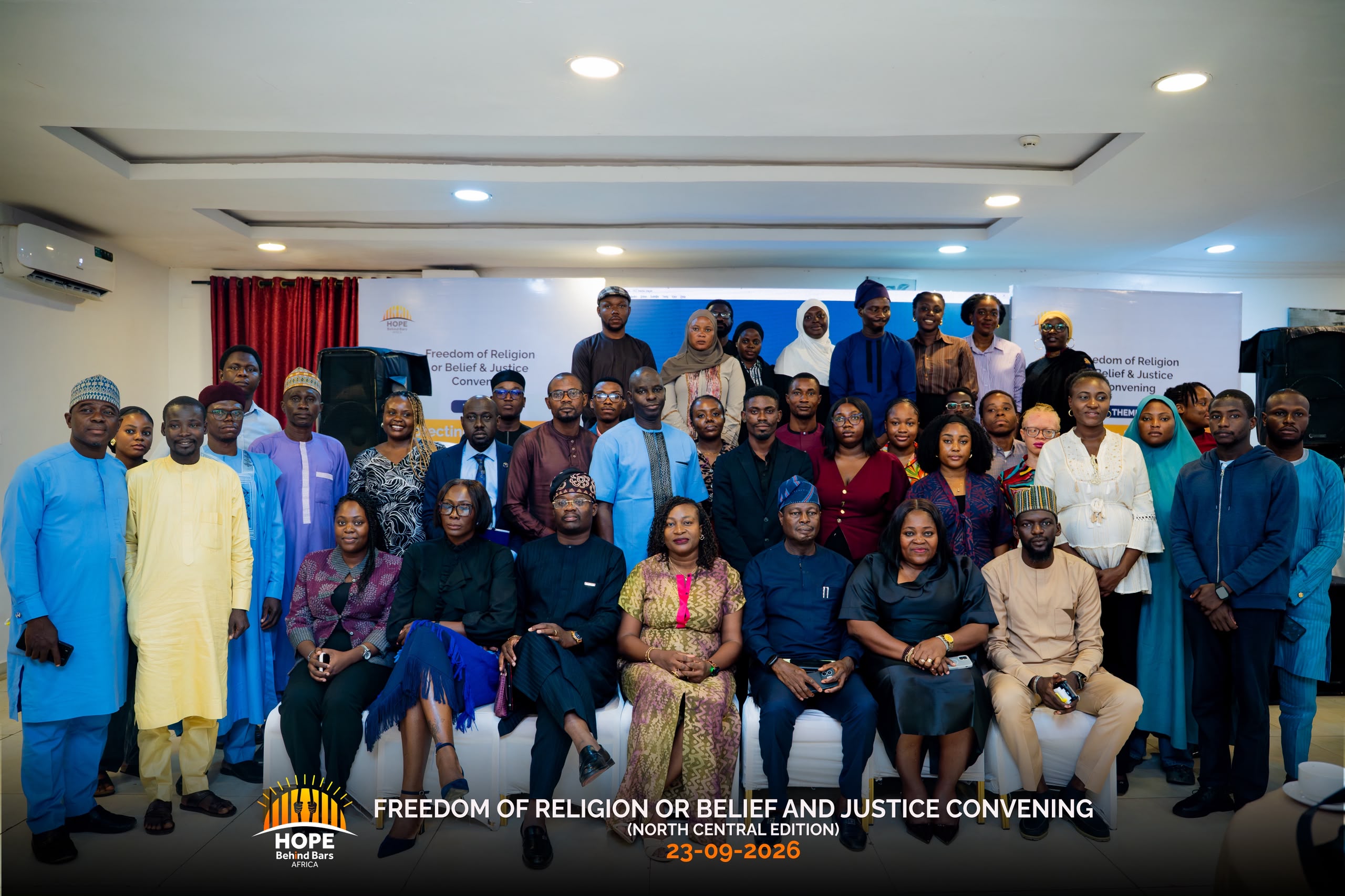
At an Abuja convening, lawyers, faith leaders and civil society actors examined a difficult question: what happens when religious belief and expression meet criminal law and the power of the state?
ABUJA — The question of religious freedom in Nigeria is often framed around tolerance: how different faith communities can live alongside one another without conflict.
But at a gathering of lawyers, religious leaders, human rights advocates, journalists and civil society actors in Abuja on Wednesday, September 23, the conversation moved beyond coexistence.
The more difficult question was this:
What happens when a person’s belief or expression comes into contact with the criminal justice system?
That question sat at the centre of the North Central Freedom of Religion or Belief and Justice Convening, organised by Hope Behind Bars Africa (HBBA) under the theme, “Protecting Freedom of Religion or Belief in Nigeria: From Dialogue to Action.”
The organisation deliberately placed freedom of religion or belief alongside criminal justice, freedom of expression, equal citizenship and state power — a framing that shifts the subject from a conversation about religious harmony to one about how rights are protected in practice. HBBA had identified concerns including restrictions on religious expression, violence affecting communities, online disinformation and inflammatory narratives as part of the wider discussion.
That shift matters.
Nigeria’s Constitution guarantees freedom of thought, conscience and religion, including the freedom to change one’s religion or belief and to manifest or propagate it through worship, teaching, practice and observance. The constitutional framework also protects freedom of expression and freedom from discrimination on grounds including religion.
The issue, then, is not simply whether freedom of religion exists as a constitutional promise.
It is what happens when that promise meets the law, public-order concerns and the authority of the state.
When a right meets the law
The tension became particularly visible during the panel session on “Freedom of Religion or Belief within Nigeria’s Criminal Justice System and the Limits of State Power.”
The discussion examined the boundaries between religious belief, religious expression and conduct that may legitimately attract legal consequences.
That distinction is important.
A belief is not automatically a crime because it is unpopular. An expression of faith is not automatically incitement because it causes disagreement. At the same time, the existence of a right does not place conduct entirely outside the law.
The difficult work lies in determining where those boundaries fall — and whether the law is sufficiently clear and applied fairly.
International human rights lawyer Tsema Ede, the keynote speaker, argued that Nigeria needs a more balanced legislative approach to religious freedom.
“There is an urgent need for a healthy and balanced legislative intervention in the area of religious freedom in Nigeria.”
Ede also linked the protection of religious freedom to the broader question of how the state exercises power.
“True security and national unity cannot be bombed or legislated into existence; they are cultivated through strict adherence to the rule of law and equal protection.”
The point goes beyond religious policy.
If citizens are unsure whether the law will protect them equally, then the problem is not only about religion. It becomes a question of confidence in institutions.
The danger of blurred boundaries
For Alex Adekunle James, Executive Director of Rivers in the Desert Initiative, the relationship between Sharia law, freedom of religion or belief and freedom of expression deserves closer examination.
He raised concerns about situations in which matters traditionally regarded as civil or family matters may enter the criminal justice system.
His warning was concise:
“We are not supposed to penalise thoughts or expression. These are things that cause this contradiction within the law.”
That observation points to one of the central challenges in protecting freedom of religion or belief: the need to distinguish belief from conduct, disagreement from incitement, and expression from criminality.
Those distinctions cannot be left entirely to public sentiment.
They have consequences for police officers, prosecutors, lawyers, judges, journalists and, ultimately, citizens whose rights may depend on how those boundaries are interpreted and enforced.
Equal protection is part of religious freedom
The conversation also raised another issue that is sometimes overlooked in debates about FoRB: whether the same legal standards are applied to everyone.
Rev. Fr. Barkindo Atta, Executive Director of The Kukah Centre, argued that hate speech and incitement should be regulated through clear laws that apply without regard to a person's identity or position.
“Hate speech and incitement should be governed by agreed laws. It should not matter who you are in the society; if you violate these laws, you should face the consequences so that we are not profiled.”
That argument introduces a crucial test for any rights-based system.
It is not enough for a law to exist.
How it is enforced matters.
Where citizens perceive that similar conduct attracts different consequences depending on religion, social status or political influence, the credibility of the justice system itself can become part of the problem.
For freedom of religion or belief, equal protection therefore cannot remain an abstract constitutional principle. It has to be visible in the way complaints are received, investigations are conducted, cases are prosecuted and disputes are resolved.
The argument is no longer confined to places of worship
The conversation also extends beyond churches, mosques and physical communities.
Religious expression increasingly takes place online, where a comment made in one location can quickly reach thousands of people in another.
That digital environment creates new possibilities for dialogue, but also new challenges.
HBBA specifically identified online disinformation and inflammatory narratives among the issues surrounding freedom of religion or belief.
For journalists, the implication is significant.
Reporting religious disputes requires more than reproducing competing claims. It requires verification, context and care with language — particularly where an inaccurate or inflammatory report can intensify an already sensitive dispute.
For public institutions, the challenge is equally difficult: responding to genuinely harmful conduct while preserving legitimate expression.
For citizens, it means recognising that disagreement, offence and incitement are not necessarily the same thing.
From conversation to accountability
This is where the Abuja gathering attempted to distinguish itself from a conventional dialogue.
Its theme was not simply “dialogue.”
It was “From Dialogue to Action.”
For HBBA Executive Director Funke Adeoye, the objective was to bring different perspectives into the conversation while pushing attention towards accountability and practical action.
“This event is also intended to amplify diverse perspectives on FoRB and draw greater public attention to the need for sustained dialogue, accountability and action in protecting fundamental rights.”
That raises the most important question about the convening:
What happens after the microphones are switched off?
A useful outcome cannot be measured only by attendance, photographs or speeches.
The test is whether conversations such as this eventually produce better documentation of violations, stronger access to legal assistance, clearer institutional procedures, greater accountability and practical mechanisms for protecting vulnerable people and communities.
That responsibility cannot belong to one organisation.
Government institutions have a role in protecting constitutional rights. Lawyers can challenge unlawful restrictions. Civil society can document violations and push for reform. Religious and community leaders can help reduce tensions. Journalists can provide accurate and responsible reporting. Citizens must also be able to seek remedies when they believe their rights have been violated.
Where dialogue will be tested
The most revealing part of a conversation about rights is often what happens after the conversation.
It happens when someone walks into a police station.
When a complaint is made.
When an allegation becomes a criminal case.
When a journalist reports a religious dispute.
When a court is asked to decide whether an expression crossed a legal boundary.
When a citizen who feels discriminated against asks an institution for protection.
That is where the promise of freedom of religion or belief moves from paper to practice.
Nigeria's constitutional framework provides the foundation. The National Human Rights Commission itself describes freedom of thought, conscience and religion, freedom of expression, peaceful assembly and freedom from religious discrimination as fundamental rights.
But constitutional guarantees are only one part of the story.
The harder task is ensuring that institutions apply those guarantees consistently when rights collide with competing interests, social tensions or state power.
That is why the Abuja conversation deserves to continue beyond the convening room.
The central question is not whether Nigerians should tolerate one another's beliefs.
It is whether every Nigerian can expect the law to recognise and protect their freedom of thought, conscience, religion and expression — and whether that protection remains meaningful when those freedoms become difficult to defend.
That is the point at which freedom of religion or belief stops being merely a question of tolerance.
It becomes a justice question.
And that is where dialogue must become action.