
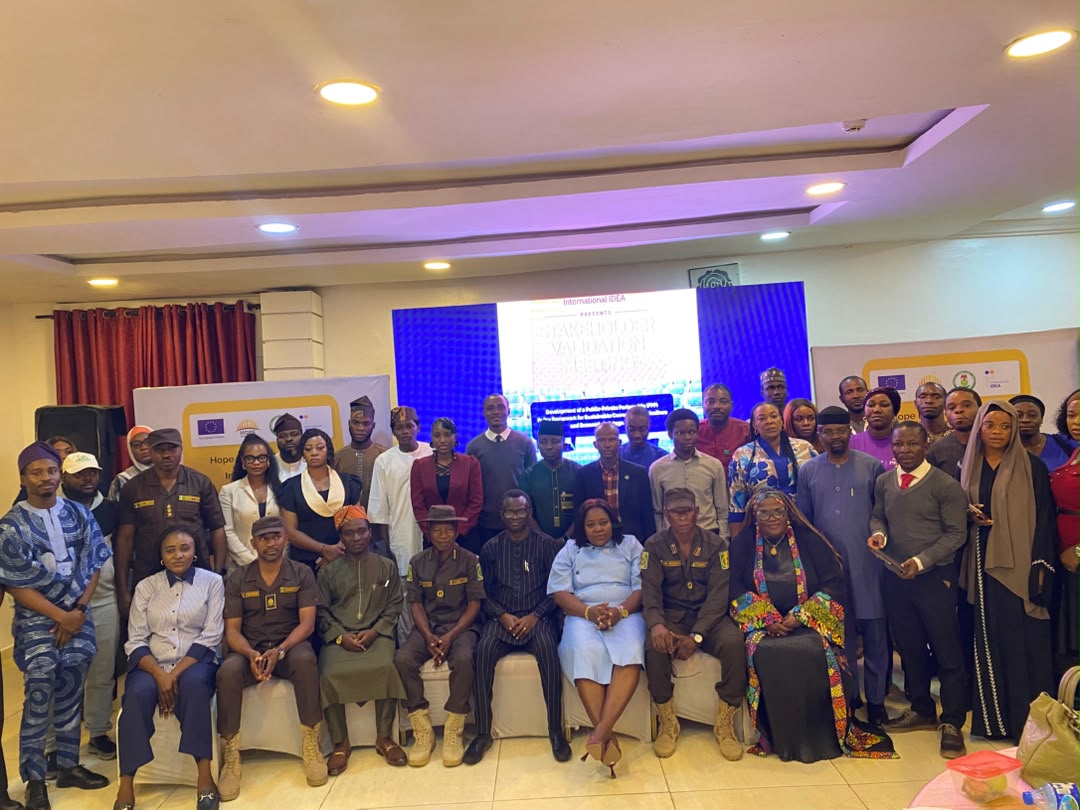
Participants at the Stakeholders Validation PPP framework for Sustainable Correctional Agriculture & Economic Reintegration.
Stakeholders from Government institutions, Development organizations, civil society and the media have called for stronger collaboration to advance sustainable correctional agriculture and create viable economic pathways for the reintegration of persons leaving correctional facilities.
The call formed part of discussions at a Stakeholder Validation Meeting on the Development of a Public-Private Partnership (PPP) Policy Framework for Sustainable Correctional Agriculture and Economic Reintegration, organised by Hope Behind Bars Africa in Abuja.
The meeting brought together representatives of the Nigerian Correctional Service (NCoS), International IDEA/RoLAC Programme, Central Bank of Nigeria (CBN), National Agency for Food and Drug Administration and Control (NAFDAC), Standards Organisation of Nigeria (SON), alongside civil society and media organisations.
Strengthening the Correctional-to-Productive Pathway
The meeting featured a presentation by Dr. Ogechi Ogu, Esq., a legal and policy expert in the criminal justice sector, who took stakeholders through the key provisions and objectives of the proposed PPP Policy Framework.
The ensuing discussions examined how stronger partnerships between government and the private sector can support correctional agriculture, enterprise development, skills acquisition and sustainable economic opportunities for inmates and persons transitioning from correctional facilities.
Giving the welcome remarks on behalf of the Nigerian Correctional Service, Etuh Simeon Paul, Assistant Controller of Correction, underscored the importance of rehabilitation and reintegration within the correctional system and reiterated the Service's commitment to supporting efforts that can help persons in custody develop productive skills and successfully return to society.
This institutional mandate provides an important foundation for exploring how correctional agriculture can evolve beyond a custodial activity into a structured platform for skills development, productivity and economic reintegration.
Second Chances Through Sustainable Opportunities
Also delivering his welcome remarks, Oluwatoyin Badejogbin of International IDEA's RoLAC Programme emphasised the importance of creating opportunities that enable people who have served their sentences to rebuild their lives and make positive contributions to society.
He highlighted the value of emerging stories of individuals who, after leaving custody, have received support to establish productive livelihoods and subsequently contributed to the lives of others facing similar transitions.
The message reinforced a central consideration behind the proposed framework: rehabilitation is most sustainable when it is connected to real economic opportunities after release.
From Farms to Sustainable Enterprises
Stakeholder contributions further broadened the framework around financing, regulation, standards, quality assurance and sustainable enterprise development.
For correctional agriculture to achieve lasting impact, participants recognised the importance of developing an ecosystem that connects production with financing, processing, standards, markets, private-sector expertise and appropriate regulatory oversight.
A well-structured PPP framework could provide the platform for these different actors to work together while ensuring that investments in correctional agriculture generate value for both the correctional system and the wider economy.
A Shared Responsibility
The validation meeting demonstrated that sustainable correctional reform cannot be achieved by one institution alone.
Government agencies, private-sector partners, financial institutions, regulators, development organisations, civil society and the media all have complementary roles to play in creating an environment where rehabilitation can translate into sustainable livelihoods.
The recommendations and perspectives generated during the engagement are expected to contribute to further strengthening the proposed PPP Policy Framework.
Ultimately, the initiative points towards a broader vision of correctional agriculture. One that combines rehabilitation, skills development, enterprise, food production and economic reintegration to give more people leaving custody a realistic opportunity to build productive lives.
As Nigeria continues to strengthen its correctional system, initiatives such as this validation process underscore the importance of moving from rehabilitation in custody to sustainable reintegration into the society.